
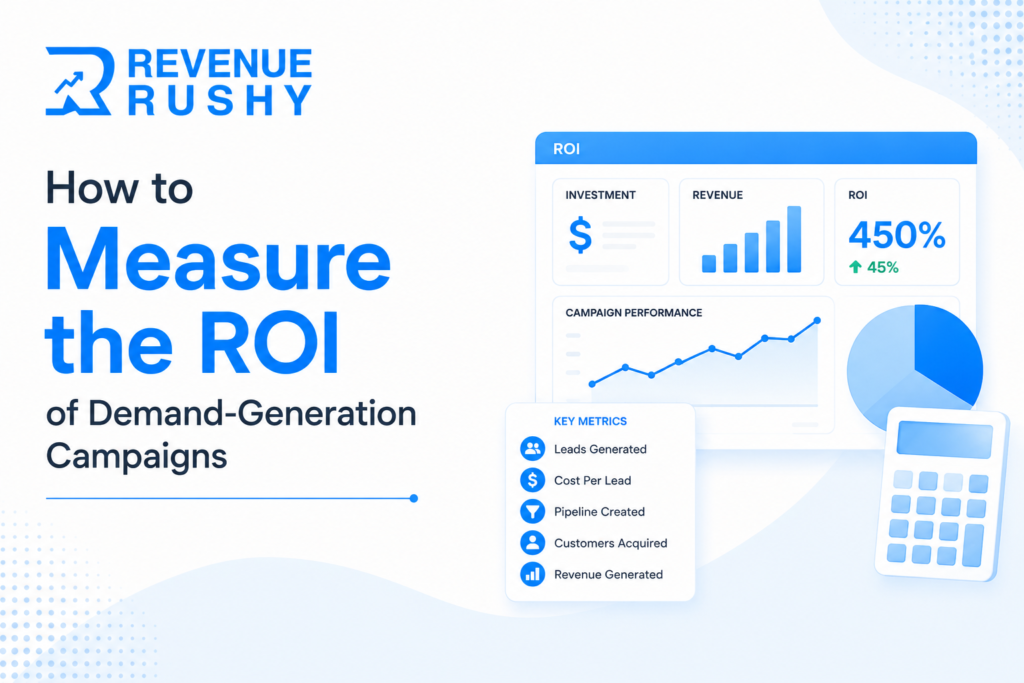
demand generation ROI, pipeline attribution, marketing ROI, customer acquisition cost, revenue contribution
Demand generation is designed to build awareness, create interest, nurture potential buyers, and generate qualified sales opportunities. However, measuring its success can be challenging because B2B customers rarely convert after one advertisement, email, or website visit. They often interact with several campaigns and channels before becoming customers.
Measuring demand generation ROI requires businesses to examine the entire buying journey rather than focusing only on immediate form submissions. Website engagement, content consumption, qualified leads, pipeline value, conversion rates, and closed revenue all provide important insights into campaign performance.
A complete measurement system helps marketing teams understand which activities influence buyers, which campaigns create genuine opportunities, and where budget should be invested for stronger results.
Track Leading Indicators of Buyer Interest
Leading indicators show whether campaigns are attracting and engaging the right audience before revenue is generated. These metrics may include website traffic, content downloads, email engagement, webinar registrations, social interactions, video views, and repeat visits.
Although these activities do not directly prove revenue impact, they help businesses understand whether target buyers are discovering and engaging with the brand. High traffic from unsuitable audiences may produce little value, while lower traffic from ideal customers may create stronger opportunities.
Qualified lead volume is another important indicator. Businesses should measure how many engaged prospects match the ideal customer profile and demonstrate meaningful buying intent.
Marketing-qualified leads, sales-accepted leads, and booked meetings can reveal whether campaigns are moving prospects toward sales conversations. These metrics provide a clearer picture of campaign quality than total lead volume alone.
Measure Pipeline, Conversions, and Acquisition Costs
As prospects progress, businesses should evaluate pipeline-related metrics. Pipeline attribution connects marketing interactions with the opportunities they helped create or influence.
Teams should monitor campaign-sourced pipeline, influenced pipeline, average opportunity value, sales acceptance rate, and pipeline progression. These measurements show whether demand-generation activity is creating commercially relevant outcomes.
Conversion rates should also be measured across every stage. This includes visitor-to-lead, lead-to-meeting, meeting-to-opportunity, and opportunity-to-customer conversion. Reviewing each stage helps businesses identify where buyers are losing interest or where the sales process needs improvement.
Customer acquisition cost is calculated by comparing the total cost of marketing and sales activity with the number of customers acquired. This may include advertising spend, technology, content creation, agency support, and internal resources.
Businesses should compare acquisition costs with customer value, deal size, and long-term revenue potential. A campaign with a higher cost per lead may still deliver stronger marketing ROI when it attracts better-fit customers with higher lifetime value.
Connect Campaign Activity With Revenue
Lagging indicators show the final financial impact of demand-generation efforts. These include closed-won revenue, customer lifetime value, return on marketing investment, sales-cycle length, and overall revenue contribution.
Revenue Rushy supports this measurement process through campaign analytics, conversion tracking, CRM data, and performance optimisation. Its approach helps businesses connect marketing engagement with qualified opportunities, pipeline movement, and revenue outcomes.
Accurate reporting requires consistent data across marketing platforms, CRM systems, automation tools, and sales activity. Teams should agree on attribution models, lead stages, qualification rules, and performance definitions.
Campaigns should also be reviewed regularly. Marketing and sales teams can identify which channels produce qualified opportunities, which content supports decisions, and which activities contribute little to pipeline growth.
Effective demand generation is not always visible through immediate conversions. A prospect may engage with several resources before completing a form or contacting sales.
For this reason, demand generation ROI should be measured across the complete customer journey. By combining engagement, qualified leads, pipeline value, acquisition costs, conversions, and closed revenue, businesses can make better investment decisions.
Learn how Revenue Rushy connects marketing activity with pipeline performance and measurable revenue growth through its demand-generation and marketing services.